Translate

Tuesday, August 09, 2022

How Beijing’s New Maritime Rules in the South China Sea Will Affect India and Others

In a classic manoeuvre of what is called “lawfare”, China announced a new set of maritime regulations last week that require ships carrying certain types of cargo to provide detailed information to the Chinese authorities when transiting through Chinese “territorial waters”.

Though such demands by littoral states are not unusual, it does not take a genius to understand that this particular move is part of an ongoing Chinese project to establish its jurisdiction over the South China Sea by using Chinese laws and regulation. Neither is the use of “lawfare” to project a country’s goals. The US routinely uses what is called a “long-arm jurisdiction” to claim global authority of its laws and regulations as part of its exercise of projecting power.

An earlier 1992 Chinese law insisted that foreign military ships needed permission to enter the territorial waters, submarines needed to transit on the surface, and ships carrying toxic material had to have required documentation and take precautions in handling the cargo.

Now according to the Global Times, vessels from foreign countries, including submersibles, nuclear vessels, ships carrying radioactive materials, bulk oil, chemicals, LNG and other harmful substances, “are required to report their detailed information upon their visits to Chinese territorial waters”.

China’s claim in the South China Sea

In January 2021, the Chinese passed a new Coast Guard Law and in April and a revised Maritime Traffic Safety Law. There is a built-in ambiguity in this move, which matches with the uncertainties surrounding China’s maritime claims in the South China Sea.

The United Nations Convention on the Law of the Sea (UNCLOS) gives military or civilian ships the right of “innocent passage” through the territorial waters of another state. Territorial sea is defined as a belt of waters extending 12 nautical miles from the baseline of a coastal state. This “innocent passage” is defined as ships that pass straight through without stopping, any exercise or practice of weapons, collecting information, fishing and so on.

Also read: From Procuring Drone Protection to Other Weapons, Indian Navy Is Ahead of Other Services

But subsequently, many countries have been concerned about smuggling, marine pollution and the dangers they faced by ships carrying hazardous cargoes. So, a number of countries like Canada, Pakistan and Portugal demand prior notification of such cargoes; Egypt, Iran, Malaysia and Yemen demand prior authorisation; and there are nations like Argentina, Nigeria and the Philippines which ban them.

China’s own definition of its territorial seas, put out by its Law on Territorial Sea and Contiguous Zone of February 25, 1992, notes that it includes waters adjacent to its mainland and its offshore islands, namely Taiwan, and Diayou (Senkaku), Pengshu, Dongsha (Pratas), Xisha (Paracels) and  Nansha (Spratly) islands. Though not explicitly stated, the waters are as enclosed by the Nine Dash Line in Chinese maps. Of these, Pengshu and Dongsha are administered by Taiwan.

Map of the South China Sea, with Nine Dash Line highlighted in green. Photo: US Central Intelligence Agency/Public domain/ Wikimedia Commons

The Chinese control the Paracels which they seized from Vietnam in the closing days of the Vietnam war in 1975. Further south, control of the islands and rocks which comprise the Spratly islands group is divided among a number of claimants — the Philippines (11), Taiwan (2), Vietnam (29), China (7), Malaysia (6) and Brunei (1).

China’s legal ability to enforce its control

In recent years, many of these claimants have dredged the maritime features and created artificial islands. But the Chinese have gone further and turned many of them into full-fledged military facilities and asserted that the seas around them are “territorial waters”.

The problem for China is that as per the UNCLOS arbitration award of 2016 relating to the South China Sea, their territorial waters in the features of the Spratly islands they control are limited.

The 2016 award, passed in relation to a case brought up by the Philippines, declared that there were no real “islands” in the Spratly island group that could support habitation and claim territorial waters of 12 nautical miles and an exclusive economic zone of another 200 nautical miles.

There were a number of “high tide elevations” or rocks that showed above the high tide, but these could only generate a territorial sea of 12 nautical miles. Further, several features claimed by China such as the Mischief Reef, Second Thomas Shoal and Reed Bank were naturally under water and did not generate any territorial claim at all. Land reclamation or artificial construction would not change the legal regime or categorisation of the features.

The tribunal also found that China had occupied certain areas like the Mischief Reef and Scarborough Shoals, which fell within the exclusive economic zone (EEZ) of the Philippines.

Finally, the tribunal ruled that any claim for the waters of the South China Sea coming under the category of “historic rights” under UNCLOS were untenable and inconsistent with the international law. This put paid to the extensive claims that China implicitly made by drawing the so-called Nine Dash Line that enclosed most of the South China sea.

In essence, the legal ability of China to use its latest regulations to enforce its expansive claims is limited. That, of course, does not mean they will not attempt to do so.

US’s involvement in the South China Sea dispute

The Chinese saw themselves as latecomers in the South China Sea and forcibly evicted the Vietnamese from the Fiery Cross Reef in 1988 and the Philippines from Mischief Reef in 1995 and blocked its access to the Scarborough Shoal in 2012.

For the US which had always been patrolling close to Chinese waters, the South China Sea developments were an opportunity to challenge China and so beginning around 2012, it began to conduct what it said were naval operations aimed at ensuring the freedom of navigation of the South China Sea waters.

This is a screenshot of real time traffic in the South China Sea from marinetraffic.com. This image as of September 3, 2021 shows that the bulk of the traffic going through the SCS is to China or Hong Kong. It actually goes in a south-west to north-east direction avoiding the Spratly Islands.

Actually, the whole issue of “freedom of navigation” is a bit of a red herring. So far, China has not sought to block any commercial traffic on the sea lanes of the South China Sea. Seven out of the 10 largest commercial ports are in China and some of the biggest shipping companies are Chinese and dependent on access to the sea lanes. As visible in the figure above, the bulk of the traffic goes to China and Hong Kong and so the Chinese are hardly likely to interdict it.

Initially, there were claims that $5.3 trillion of global trade passed through the South China Sea, but a detailed analysis by the US think tank Center for Strategic and International Studies found that the actual estimate for 2016 was more around $3.4 trillion, which constituted 21% of global trade, not 36% as earlier claimed.

The study also found that while 64% of China’s maritime trade went through the waterway, 42% of Japan’s did so. Just 14% of the US trade passed through the region.

There was another important component to the South China Sea equation. The  Chinese undersea nuclear weapons capability is housed in submarines whose principal base is in the Hainan Islands. The Chinese subs do not intend to roam the world oceans, but be used from locations in the deep seas close to Hainan in what is called the “bastion” mode. Hence, there is considerable sensitivity to the US movements that take place in the name of “Freedom of Navigation Operations” (FONOPS).

Also read: Ladakh Stand-off Has Exposed India’s Failed Nuclear Deterrence against China. Now What?

For the US, the South China Sea represents a useful way of checking Chinese power. Regional countries have welcomed the US’s military presence because of Beijing’s bullying ways. But the US has been chagrined to find that while these countries benefit from the presence of US power, they are unwilling to join  any coalition to confront China. As is well known, China is the ASEAN’s main trading partner.

So, the US has put its money down in the Quadrilateral Grouping (Quad) of extra-regional states like Japan, India and Australia. While Japan does have significant interest in the freedom of navigation in the South China Sea, a lot of its heavier traffic comes through the Lombok Strait.

As for India, as of 2019-20, just about 18% of its trade went through the South China Sea, but the bulk of it went to China. Fanciful claims that more than 50% of its trade goes through the waterway are simply not borne out by the figures. India’s trade with China topped $81 billion during this period, while the combined value of its trade with South Korea, Japan and Taiwan was half that figure, and to this add $34 billion for Hong Kong. India’s total global trade stood at $844 billion during that period.

India has another leverage against Chinese efforts to interdict our traffic — it can do the same to the China-bound traffic in the Andaman and Nicobar Islands area where it sits at one end of the Malacca Straits.

China is unlikely to back off from its expansive and ambiguous maritime claims. It is now seeking to work out a Code of Conduct with the other claimants, but it wants them to agree to a declaration that extra-regional powers are kept out of issues relating to the South China Sea.

But whether Beijing likes it or not, the arbitral award has been a dampener in its effort to consolidate its authority over the area through lawfare. Issues like the latest notification are more by way of being used as pinpricks rather than a useful means of expanding Chinese control.

The Wire 4 September 2021

https://thewire.in/south-asia/explained-what-lies-behind-beijings-new-maritime-rules-in-south-china-sea

With US’ Shameful Rout from Afghanistan, Who Can Trust America Again?

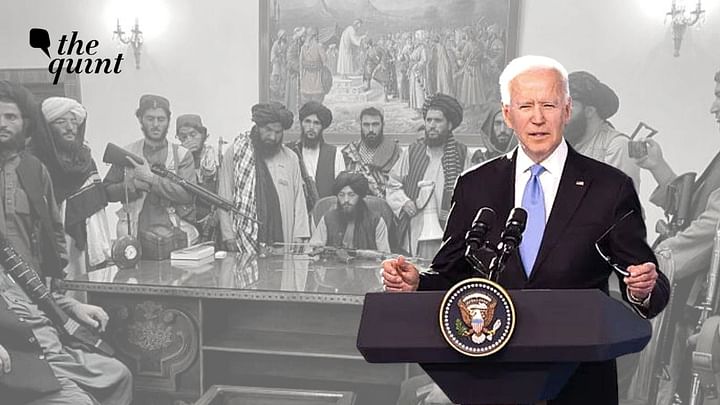
“I was not going to extend this forever war, and I was not extending a forever exit … The fundamental obligation of a president, in my opinion, is to defend and protect America, not against threats of 2001, but against the threats of 2021 and tomorrow. That is the guiding principle behind my decisions about Afghanistan,” said US President Joe Biden in his address to Americans a day after the last US troops left Kabul.

There are many words to describe what the Americans and the NATO have done in Afghanistan. You could use the neutral term “withdrawal”, but any objective person would describe what happened to them as a combination of a retreat and a rout.

True, the withdrawal was in reasonably good order, and but for 13 soldiers killed in last Thursday’s bomb attack, the US did not suffer casualties. But how do you judge an army that left behind a vast quantity of weapons and equipment on the battlefield and abandoned thousands of supporters whose lives and liberties could be at risk at the hands of the Taliban?


The Shock Departure From Bagram

True, a large number of the weapons are those supplied to the Afghan National Security Forces (ANSF) that collapsed in the face of the Taliban. Between 2002-2017, the US gave the ANSF $28 billion worth of weaponry, including guns, rockets, night-vision goggles, some 2,000 armoured vehicles, 40 aircraft, including UH-60 Black Hawks, Scout attack helicopters and ScanEagle drones. Now, all of it is with the Taliban.

But the real measure of American incompetence came through its decision to abandon its major and well-protected base in Bagram, an hour’s drive from Kabul, without informing the Afghans. Remarkably, this hubristic act took place on 2 July, two days before the 245th year of American independence.

This shock departure, complete with the lights being turned off at the time of departure, was the final knock-out punch delivered to the ANSF’s gut. At one stroke, it wiped out a key battle-winning attribute of a military force — morale. Till this time, not a single of Afghanistan’s 34 provincial capitals had fallen to the Taliban.

The cruel irony is that two weeks later, 6,000 American troops had to be sent back, this time to the less secure Kabul airport, to carry out the evacuation of civilians.


Is the Afghan Army Really To Blame?

It is easy now to blame the ANSF for incompetence and even cowardice, but a closer analysis would reveal that the larger US plan for leaving the country, which had been in place for a decade, was deeply flawed. Instead of leaving behind a fully functioning army, the ANSF was crucially dependent on US air, intelligence support and maintenance support. When that was abruptly cut off, they lost heart. Sensitive to Pakistani concerns, the US had not allowed the ANSF to develop all the capabilities needed by a modern army.

In contrast, in 1989, the Soviet Union had conducted a fighting retreat and put in place a government under Najibullah, which successfully took on the Mujahideen till the Soviet Union collapsed and the Afghan state ran out of money and support and was overwhelmed by the US-Pakistan-Saudi supported jihadis.

There are other issues as well about the American “withdrawal” that should concern us. For example, the US did not involve the elected government of Afghanistan in the process at all. The Ashraf Ghani government was elected by a minority of people in an election that was controversial. Yet, for advocates of democracy like Biden, it had sufficient legitimacy so that its exclusion from the peace process was tantamount to a travesty.

Indeed, by excluding the Ghani government from the peace process, the US effectively delegitimised it. It was left to Russia to host talks involving the Taliban and the Afghan government’s High Peace Council.

Close regional friends like India, too, were excluded from the process whose aim seemed to be to get the Americans and the NATO out of Afghanistan, regardless of consequences. Incidentally, and South Block needs to note this, as per the Doha deal, the Taliban commitment to not allowing its soil to be used to threaten the security of others is limited to “the United States and its allies”.

After the deal was signed, the US and NATO contingent got busy with dismantling their bases. Freed from worries about them, the Taliban intensified their attacks against the ANSF, contrary to the letter and spirit of the Doha accords.


A String of Foolish Decisions

There is another question mark here, this one relating to NATO, since this was seen as the first mission in the outfit’s history where the collective defence provision under Article V was invoked. The Americans may have done the heaviest lifting in the Afghan war, but its NATO allies — Germany, France, Britain, Canada, Turkey, Norway, Belgium, Sweden and other members — also had troops fighting on the ground till 2014. Thereafter, it became an advisory mission. But the US eventually signed a bilateral deal with the Taliban in February 2020. It may have kept its allies in the loop, but the eventual denouement in Kabul is not something that will have heartened the Europeans.

A former US ambassador to Afghanistan, Ryan Crocker, has written about the lack of strategic patience on the part of the US in dealing with the situation that presented itself in the country. The problem is that in relation to the withdrawal or retreat, even tactical patience was missing.

As another writer pointed out, it was foolish to withdraw at the height of summer when the Taliban are out in full strength, where they could have been confined to their sanctuaries had it been winter.

But more germane is the issue of announcing your departure by a particular date. This gives the adversary a huge advantage in that they can decide the pace and momentum of their campaign.

Instead, the Americans should have used the metric of conditions on the ground. They could have asked for a ceasefire pending final withdrawal or the completion of negotiations between the Afghan government and the Taliban, and pending that, maintained the token force of 2,500 personnel they had at the beginning of this year when the government controlled all the urban centres.

Indeed, the first provincial capital to fall, Zaranj, was as late as August 6. Located near the Iran border, this is the start point of the Indian-built road leading to Delaram, aimed at linking Afghanistan to the outside world through Chah Bahar.


No, the US Won't Turn Its Focus to China

There is some facile analysis that argues that having given up its long-running liabilities in the Middle East, the US will rebound with greater vigour in confronting China in the Indo-Pacific. This analysis fails to understand the current isolationist current in the United States, which would hardly back a military venture against a major power like China after having suffered a catastrophe in Afghanistan and Iraq. Also, how much trust would friends and allies retain in the US, given the way it handled its Afghan departure?


Given the American record in Afghanistan, it would require a brave person to accept that what happened in Kabul was an aberration and Washington will now neatly and strongly pivot to the Indo-Pacific.

Leave alone allies, the impact of the Biden administration’s handling of the situation has left deep scars on the US itself, especially its armed forces. This is evident from critical statements like that of serving Marine colonel Stuart Scheller and the retired military fraternity. There was a time when the stoic acceptance of casualties marked the American warrior ethos. Today, that seems to have been shredded, with the relatives who lost their near and dear excoriating Biden for his handling of the situation.


The Quint, September 1, 2021
https://www.thequint.com/voices/opinion/us-exit-from-afghanistan-was-no-withdrawal-it-was-a-shameful-rout#read-more#read-more

Taliban’s charm offensive

As the Taliban cement their total victory in Afghanistan, the message coming out from their leaders is one of conciliation and moderation. On Sunday, one of their top leaders, Sher Mohammed Stanikzai, confirmed the Taliban’s commitment of not allowing their territory to be used against any country in the world. Specifically, he said they would not allow India and Pakistan to play out their rivalry in Afghanistan.

Indeed, Taliban leaders Zabiullah Mujahid, Suhail Shaheen and Stanikzai have spoken of their expectations that India will continue to maintain its ‘cultural, economic and trade ties’ with the new Emirate of Afghanistan and retain its invaluable ‘air freight corridor’ with it.

But these are still early days. The Taliban may have taken over power in Afghanistan, but now they are figuring out how to run it. The Taliban are warriors and have zero administrative experience, leave alone a cadre that can manage a city of the size of Kabul. The cities they ran in their brief reign between 1996-2001 lacked running water, electricity, telephones, and existence there was basic. But in the last 20 years, there has been a sea change, with cities having modern facilities, ranging from cafés to schools, malls and gyms.

The big question before any putative Taliban administration is: Who will pay for the import of food, oil, salaries of government personnel, and the running of even a rudimentary administration? Hence, the rational calculation would be for them to moderate their extreme views and get assistance from abroad. The economy of their closest friend and mentor, Pakistan is down in the dumps and so are those of Russia and Iran. That leaves the US and its European allies and maybe the Gulf states.

The US and the Europeans are unlikely to unbelt aid to an unreconstructed Taliban. The issue is not the Sharia or democracy, considering that Saudi Arabia and Israel are close American allies. But they would be affected by the optics of a Taliban chopping off hands or banning women’s education.

Trying to understand how things could unfold is not easy. This new Taliban is a decentralised outfit which has expanded beyond its original tribal remit, hence its success in the northern part of the country dominated by the Uzbek and Tajik ethnicities. No one is clear as to their power structure, yes, there is a supreme leader, Hibatullah Akhundzada, the emir-ul-momineen, and a shura in Quetta, there are also figures like Abdul Ghani Baradar and Stanikzai who seem to be their ‘secular’ leaders, as well as people like Khalil and Sirajuddin Haqqani who have uncomfortably close links to Pakistan. There are other centres of power that are not quite visible — the Mashhad shura comprising Taliban leaders sheltering in Iran.

The Taliban may have prevailed over the Americans and Europeans, but there remains a dangerous and volatile mix of Islamist radicals and other forces that have significant roots in Afghanistan. Among these are the Islamic State of Khorasan (ISIS-K), Al- Qaeda and the Panjshiris. They are concentrated in the north-eastern part of the country where the Afghan-Pakistani cadre of the ISIS-K has about 2,000 fighters. The Panjishiris say they also have thousands of fighters. This is also an area close to Xinjiang and will generate concern in Beijing.

All estimates place the armed component of the Taliban at around 60-70,000, which is simply not enough to hold the country by force and take on their domestic opposition. In other words, the outfit needs to have some form of legitimacy. Just how they will manage—through western style elections, or some kind of a Loya Jirga — remains to be seen. The ISIS-K bomb attack in Kabul was aimed as much at the US as the Taliban, to show that the latter are not capable of controlling the country.

In recent weeks, we have seen distinct signs of accommodation between the Taliban and the US. Though insistent on the August 31 deadline, the Taliban have cooperated with the American evacuation and reportedly also sought to prevent last Thursday’s ISIS-K bomb attack. They have criticised the American action and condemned the Americans for not informing them before ordering the strike.

The primary concern of Afghanistan’s interlocutors — the US, Europe, China, India, Central Asian Republics, Russia, Iran and even Pakistan — is that the country stabilises at the earliest.

In all this, where should India stand? In the UPA period, India committed significant sums of money as part of the project of building modern Afghanistan. But today, the Indian economy is faltering and New Delhi desperately needs all it has for meeting the Chinese geopolitical challenges closer home, in our immediate neighbourhood.

However, it is in our interest to help the emergence of a stable Taliban regime. They have never sought to export their medieval version of Islam; their fault was in allowing others to use their territory to train terrorists. If they are committed to prevent this, the world would be ready to do business with them.

India may not be able to fund projects in Afghanistan, but it could, and should, promote trade which currently stands at around $1.5 billion. This will be a more sustainable way of helping the country. Though Chabahar is there, more could be gained if Islamabad removed its blockade of overland Indian exports to the country. Maybe the new Taliban government can prove to be more persuasive in this area than the earlier government was.

The Tribune 31 August 2021

https://www.tribuneindia.com/news/comment/talibans-charm-offensive-304306

Can Quad Withstand China's Use of Afghan Mess to Prove American Decline?

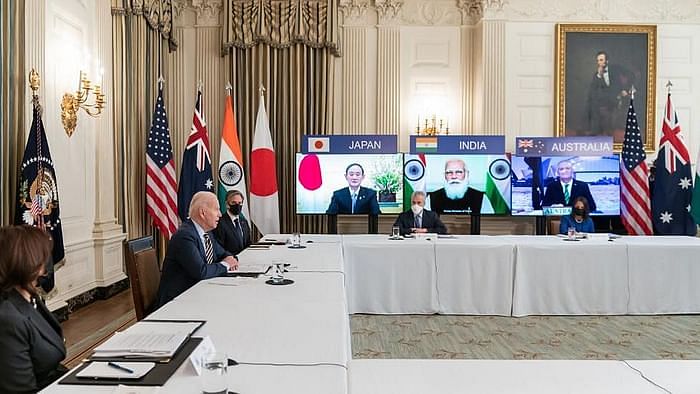
On the face of it, there should be little or no impact of the events in Afghanistan on the Quadrilateral Grouping (Quad) comprising of the US, Japan, India, and Australia. According to the summit statement issued on 12 March, the outfit may share a common vision for a “free and open Indo-Pacific” , but it is about quadrilateral cooperation in a range of areas like tackling COVID, mitigating climate change, dealing with cyber security and critical technologies, counter-terrorism, quality infrastructure development and so on.

But those are only the declared goals of the Quad. Everyone knows that its real aim is to push back at China in the Indo-Pacific region.

And there, the question of the impact of the developments in Afghanistan on the Quad is legitimate. Many views have been put forward, some suggesting that the developments will enable the US to now focus on China and the Indo-Pacific, others argue that Taiwan could become more vulnerable.


India's Military Perspective Differs From US Outlook

The very fact that the Quad has chosen not to clearly articulate a common military outlook is a weakness in itself. That means that its four constituents do not share a common perspective here. Two of them—Australia and Japan—are linked through bilateral security ties with the US, and Uncle Sam is their ultimate security guarantor.

India stands out as an independent nuclear weapons power with a substantial military that does not need the US to defend itself. Further, while it may share a maritime perspective relating to the freedom of navigation of the seas, its security also has an important continental dimension where developments in Afghanistan, Iran, Pakistan and Central Asia matter. And often India’s perspectives are at variance with the outlook of the US.

Just how things stand is obvious if you read the press releases of the United States and India following the most recent consultations of the senior officials’ of the Quad. While the US one leads off saying “senior officials discussed the importance of peace and tranquility in the Taiwan Strait, ongoing crisis in Burma…” The Indian one does not mention Burma or Taiwan.


Afghanistan Debacle Affects US-Taiwan Relations the Most

Perhaps the biggest question-mark the US debacle in Afghanistan has left relates to the US and Taiwan. The Chinese media had taken to taunting the US with Hu Xijin, editor of the Global Times saying that with the fall of the Kabul regime “the Taiwan authorities must be trembling.” Senior Taiwanese officials, speaking on condition of anonymity, said that they could now not rely on the US, and President Tsai Ing-wen made it clear that the country would have to rely on its own strength and determination to defend itself.

Given the touchy question of the international status of the island republic, American policy was best characterised by the term “strategic ambiguity.” Three joint communiques (1972-1982) provide the US commitment to recognising the People’s Republic as the sole legal government of China and that there would be no political relations between the US and Taiwan.

These have been refined by the Taiwan Relations Act of 1979 wherein the US has recognised the “one-China” principle and defined the nature of relations with the “governing authorities of Taiwan.” The Act is silent on security guarantees against a Chinese attack, but it requires the US to provide arms to Taiwan to defend itself.

Also Read


India Needs To Be ‘Aatmanirbhar’ For Semiconductors — Taiwan Can Help

Big Question Mark on America's Credibility?

In a recent interview with ABC News Biden was prodded on the comments in the Chinese media that the Afghan situation showed that the US could not be relied on. In his response Biden declared that the US had iron-clad treaty commitments with South Korea, NATO and Japan to come to their defence, and then he also added Taiwan to the list.

Given the ongoing US-China tensions over Taiwan, this created consternation, but a Biden Administration official quickly calmed the situation by declaring that US “policy with regard to Taiwan has not changed,” and it was quietly let out that the President had “mis-spoken.” In fact Kurt Campbell, the Indo-Pacific policy coordinator of the Administration had earlier rejected the possibility of giving Taiwan an explicit security guarantee.

Subsequent to the President’s gaffe, US National Security Adviser Jake Sullivan clarified that US commitments to its allies and partners remained strong, but that “when it comes to Taiwan, it is a fundamentally different question in a different context (to Afghanistan).”

An anonymous official added that the mission of the US in Afghanistan was quite different from the commitment to maintaining peace and stability across the Taiwan Strait.

Also Read

'

'No US Interest in Afghanistan With Al Qaeda Gone': US President Joe Biden

America's Tattered Will on Afghanistan May Not Automatically Mean the Same for Indo-Pacific

At the end of the day, all commitments and agreements are merely pieces of paper. What matters more is the sense of common interests in upholding them. As of now there is nothing to suggest that that has eroded in the case of the United States and its treaty allies and partners. What has happened is that some questionable American commitments made in the last twenty-odd years have come apart, for the simple reason that they were based on false premises.

But when it comes to, say, South Korea, Japan, Australia, NATO and even Taiwan, the US knows that their security and stability has a direct relationship to its homeland security and prosperity. They are linked not just through a piece of paper or some Congressional statement, but the nuts and bolts of trade and technology supply chains which, if disrupted, would damage the US as well.

America’s declassified Indo-Pacific Strategy put it across bluntly earlier this year that the principal US national security challenge was “how to maintain US strategic primacy in the Indo-Pacific region an promote a liberal economic order while preventing China from establishing new, illiberal spheres of influence.”

This is a goal to which all four Quad countries are aligned with and they all know that it depends crucially on not just American military and economic power, but US will. That may appear tattered and broken in relation to Afghanistan, but that need not automatically be the case for its Indo-Pacific policy.


Dangers Lies in China's Use of Afghanistan Policy Disaster 

The instrument of that policy is the Quad, and there is nothing in the publicly outlined aims of the Quad that should be affected by the Afghan debacle. The Quad is being smart by adopting an unexceptional low-key approach that is based on the Biden’s view that the two countries need not have a conflict, but engage in “extreme competition.”

There is nothing in the Afghan experience can detract from the Quad’s commitments on vaccines, emerging technology cooperation and so on.

The Indo-Pacific policies, however, are an entirely different issue since various countries, including those in the Quad, have no agreed definition of the region itself, leave alone a common policy.

The real danger is not the taunts on Taiwan, but the manner in which Beijing will seek to use the Afghan policy disaster to put out the narrative of the American decline. This is a longer term and insidious project. And this is something that the US needs to answer not by displays of military power, but setting its own divided house in order back home.


The Quint August 21, 2021
https://www.thequint.com/voices/opinion/can-quad-withstand-chinas-use-of-afghan-mess-to-prove-american-decline-biden#read-more%23read-more%23read-more#read-more

The fall of Afghanistan

The American retreat from Afghanistan will have consequences quite different from those faced by Russia in 1988, which in turn, were different to what Britain had to deal with in 1842. Likewise, the worldly-wise Taliban of today will not be similar to the earlier generation led by the messianic Mullah Omar. That said, it is more difficult to forecast how the future will unfold in the region.


Managing a retreat is considered one of the most complex operations of war. What we have had to witness, in the case of the Americans and the Afghan government, is more rout than a retreat, for which President Biden, his predecessor Trump and their Afghan counterpart Abdul Ghani are responsible.

Ads by 
Advertisement

Things could have been better managed since it’s been clear since 2014 that the US was done with the war. In February 2020, they made an agreement with the Taliban to withdraw from the country in 14 months in exchange for their nebulous commitment to a peace process. As the US got into departure mode reducing its forces and dismantling its bases, the Taliban stepped up operations against the Afghan army. Despite that, the Biden administration stuck to the deal and made an abrupt departure from the principal American base at Bagram in the middle of the night on July 5.

As Frederick W Kagan has observed, the fighting in Afghanistan is seasonal, with the Taliban retreating to their bases in winter. By withdrawing suddenly at the peak of summer, when the Taliban were out in full force, the US action enabled them to rapidly capture the cities one by one.

The core of the success of the new Taliban has been the ability to combine diplomacy with their military prowess. Even as their forces were positioning themselves to capture the cities, Taliban delegations were fanning out to reassure neighbours and prevent the emergence of any new counter-force.

Within days of the US departure from Bagram, a delegation was in Moscow to offer assurances that their gains on the ground would not translate into threats against the Russians or their Central Asian allies. A few days later, another delegation was in Ashgabat to reassure Turkmenistan. In early July, the Taliban participated in an Iranian-led exercise to hold talks with the Afghan government delegations to promote a peaceful settlement.

Tehran had long been supporting the anti-American Taliban with money and weapons. In 2015, a high-ranking Taliban delegation had visited Iran to discuss ‘regional issues’, and in January this year, a delegation had again visited Tehran.

China, too, has maintained ties with the Taliban for some time now. It has been concerned about the threats that could emerge from a US-dominated Afghanistan, or from a resurgent Taliban. Last month, its foreign minister Wang Yi held a widely publicised meeting with a Taliban delegation in Tianjin.

And then there is Pakistan. Islamabad believes that it has the Taliban by their ‘tooti’ (scruff of the neck), a term once used by Pakistan’s Chief of General Staff, Lt Gen Mohammed Aziz, during the time of the Kargil operations. Pakistan provided the Taliban financial resources, training, weapons, logistical support and, most important, a safe haven to fight the government and the US forces in Afghanistan. It has also been part of the ‘Great Game’ against India. A Taliban-controlled Afghanistan will eliminate Indian threat through Afghanistan.

But history doesn’t repeat itself. The Taliban of today are not the naïve Talibs that the Pakistanis created under the leadership of Mullah Omar. This generation are seasoned militants who have sometimes experienced jail and ill-treatment at the hands of the Pakistanis. Islamabad hopes that its control over the Taliban logistics will continue to provide it leverage, as will the presence of its powerful proxy—the Haqqani Network which has been absorbed into the Taliban over the past two decades. But the rapid consolidation of authority over Afghanistan by the Taliban and their outreach to Iran is likely to have upset those calculations.

Without doubt, India is a loser in these developments. It was kept out of the peace process by both the US and the Russians. We had, in any case, functioned there under the American military umbrella. Our effort to develop alternative means of access to the country through the Chabahar port means little now. The prudent course would be to cut our losses and wait.

The biggest loser in all this, besides the poor Afghan people, is the US, which must reflect on its inability to successfully see through wars, despite its enormous military capability. This has implications for its west European and East Asian allies, as well as the Arabs, who depend on the US military to protect themselves.

The Kabul fiasco will undoubtedly affect the US ability to mobilise coalitions against a common cause. With a hostile Iran and Afghanistan, the newly proposed US quadrilateral in Central Asia is a non-starter.

As the ‘Great Game II’ ends, the ‘Great Game III’ will begin. The new Taliban has a much wider regional perspective than its predecessor. They are jihadists and will continue to support Islamist causes. The Iranians and Russians have their own sense of history. The Americans are unlikely to forgo the ability to intervene in such a key region at some future date. But for that you need an America that can learn the right lessons, overcome domestic divisions and avoid the perils of groupthink that afflict large parts of Washington.

The Tribune August 17, 2021

https://www.tribuneindia.com/news/comment/the-fall-of-afghanistan-298191