Translate

Friday, December 04, 2020

Putting the blocks on China

The government has issued rules to screen foreign direct investments (FDI) from neighbouring nations. This is a too-clever-by-half way of blocking Chinese investments, but even so, action was timely and well-intentioned. There is need to protect the fire sales of corporate assets in the wake of the coronavirus outbreak. But focusing on China was not a good idea. After all, what difference does it make if a predatory investor is German, American, Chinese or Singaporean?

Restricting investment in strategically important areas is already established policy. It covers things like defence, railways, atomic energy, space, broadcasting, and so on. In 2010, BSNL barred Chinese companies from bidding in its tenders covering the northern and eastern zones. Subsequently, rules were put in place for security clearance for equipment originating in China. Earlier this year, the DoT got the right to bar Chinese firms from government telecom tenders.

But a great deal of Chinese investment in India is not in strategic sectors but in autos, pharmaceuticals and even companies like Ola and Paytm. The irony is that Chinese FDI has been coming into India in ever larger volumes ever since PM Modi came to power. According to a paper by Ananth Krishnan for Brookings, till that point, total Chinese investment was of the order of $1.6 billion. By 2017, this had risen to $8 billion, not accounting for investment coming in through entities in Singapore.

Chinese companies had earlier been investing in infrastructure, including railway equipment and steel, and power. Indeed, Krishnan points out that from a one-way dependency on China for telecom equipment, semiconductor devices, antibiotics and active pharmaceutical ingredients, the pattern of Chinese trade and investment has been changing.

The post-2014 investment has been in tech startups, pharma, renewables, like solar and wind energy, and consumer goods. Another major area has been automobiles, where the Chinese company SAIC, with its MG motors brand, has invested big and has bigger plans to focus on electrical vehicles as well.

Chinese giants Alibaba and Tencent have been active in 2016-17. The former took minority stakes in Paytm, Snapdeal and Big Basket. Tencent took even bigger stakes in transport, food delivery, education and health sectors, and put down serious money in Ola, Flipkart, learning app Byju’s, and healthcare startup Practo. The Chinese have been dominant players in the mobile phone market, with Xiaomi taking the lead. The company has also spread its money on more than a hundred startups.

Clearly, what Krishnan reveals is that there is a huge space between investments that can affect Indian security, and those that can enhance Indian well-being, through investments, jobs and consumer products.

The problem in a lot of commentary that we see in the Indian media on China is tinged by Sinophobia. China is a neighbouring country with whom we have a disputed border and which uses our estrangement with Pakistan against us. But we also have a cooperative relationship with the country, marked by our membership of BRICS, the SCO and the Asia Infrastructure Development Bank (AIIB), and so on. In recent years, PM Modi has cultivated a special relationship with China’s President Xi Jinping, marked by the informal summits at Wuhan and Mamallapuram, that the leaders have now institutionalised.

Currently, an anti-China mood has gripped the US, which is in considerable measure itself to blame for it. Between 1980 and 2010, it convinced itself that China was on its way to becoming an open, and even democratic society. Ties with China hugely enriched its multinationals, but did not trickle down to society. But their own missteps—the hugely expensive wars of the last two decades, and a refusal to invest in education, healthcare and basic research has now come to haunt them.

The US has shifted its approach to China, but it is not something which has any lessons for us. Our problems with China have a dynamic of their own, and we have the ability to deal with them.

More important, our national aim is different from theirs: The US seeks to preserve its global primacy, while China wants to shake it. We are not in that league. At present, we can have only one national goal—to end the impoverishment and deprivation of hundreds of millions of our citizens.

For this, we need investment and investment, along with trade, trade and more trade. Yes, we need a secure periphery, but though we have our difficulties with China and Pakistan, neither is an existential threat to us.

Even so, the government is right to ring-fence sectors which it deems important for security. But that still leaves a vast area in which Chinese FDI can aid our project of national transformation. This should not be a matter of ego. India and China are no longer competitors in the economic field. Unlike the situation in 1980, China’s GDP and its trade volume today is several times ours.

Take FDI. Despite poor relations with the US, China still managed to get $204 billion in 2019 as compared to $ 42 billion that we got. China sent out FDI worth $97 billion in 2018, not counting the $ 75 billion that went out from Hong Kong. As a manufacturing superpower and as a trading nation, China has a vast pool of experience which can benefit us.

Chinese companies will profit from their investments, but don’t forget, in investing in India, they are the ones who are risking serious money. We still retain sovereign control over on what and how it is spent.

Tribune April 28, 2020

https://www.tribuneindia.com/news/comment/putting-the-blocks-on-china-77178

Darwinian world order: 2008 was different, there was global cooperation and no blame game about subprime origins

In June 2003, when Prime Minister Atal Bihari Vajpayee’s delegation arrived in Beijing, the bustling city was eerily quiet, with hotels, restaurants and roads empty. The SARS epidemic was peaking and Beijing remained in the list of “affected areas”. The Chinese were visibly grateful for the visit whose consequences were far reaching. It laid the foundations of Sino-Indian economic relations and a fast track to resolve their border dispute. The two countries grew sharply in the next decade and even rode out the 2008 economic crisis. That they did not resolve their border issue is another story.

This segued into an era of political calmness of leaders like Manmohan Singh, Hu Jintao and Barack Obama. There was no blame game about the subprime origins of the 2008 recession, instead an atmosphere of cooperation led to accords on diverse issues like climate change and Iran’s nuclear problem. The global trading order evolved in new directions with TPP. The world has taken a different tack today. As the Covid pandemic kills by the thousands and brings the world economy to its knees, it’s each nation for itself, global leadership is marked by its absence.

In the past decade we have seen China militarise the South China Sea, Russia invade Crimea, plus the US demolish international accords, walk away from TPP and attack international institutions like WTO and WHO. But most worrisome now is the incipient conflict between the US and China, whose fallout will affect the world.

The US under President Trump believes that Beijing is bent on replacing its primacy as the world’s leading military and economic power. Actually, the US is itself responsible for its relative decline through wars in the Middle East. But what is really sapping US strength is internal division.  NYT has shown that while US GDP rose 79% since 1980 after adjusting for inflation and population growth, the after tax incomes of its rich increased 420% but those of the bottom and middle rose only 20% and 50%.

The political consequence of this was Donald Trump. In his policies against immigration, globalisation and China, he has spread the blame everywhere except where it really lies: the narcissistic ruling class of the US. This has failed the country, as well as the world, which depends on US leadership at times like this.

Even so, the American decline has been only relative. US GDP per capita is around $65000 while China’s is around $9500. As for military expenditure, China’s $250 billion pales before America’s $649 billion in 2018.  Beijing is a long way away from having the capacity to replace the US as the global hegemon.

Given their own shoddy handling of the Covid outbreak, Trump and the Republicans believe they must demonise China to win the November elections. Leave alone the Phase I trade deal, Trump could, under pressure from the Biden campaign, double down on measures he has been taking  on 5G and proscribe trade in other areas related to Beijing’s  Made in China 2025 project – robotics, AI, electrical vehicles, green energy, aerospace, power, pharmaceuticals etc.  China would be hurt badly but coming on top of the Covid crash, it could have a devastating ripple effect not just in East and Southeast Asia but the world.

Unlike SARS, Covid has accentuated the negatives of the global order with consequences still unfolding. In the US alone 26 million people have lost their jobs, across the world it could bring mass starvation and the impoverishment of hundreds of millions who made it out of poverty in the last two decades.  It has doubled down on the Darwinian world Trump has made, where survival is only for the fittest. The Chinese will bully their South China Sea neighbours, even while being bullied by the US, and President Putin will go on with his games in Ukraine. As for the small and the weak, they’ll have to learn to swim with the tide or go under.

https://timesofindia.indiatimes.com/blogs/toi-edit-page/darwinian-world-order-2008-was-different-there-was-global-cooperation-and-no-blame-game-about-subprime-origins/

Times of India April 25, 2020

Monday, July 06, 2020

Coronavirus Has Made China’s Diplomats Turn Into ‘Wolf Warriors’

In 2015, Wu Jing—a Chinese martial artist, film star and director—produced Wolf Warrior about an elite Special Forces unit. Simply put, the film was Rambo with Chinese characteristics. In the spectacularly successful Wolf Warrior II, made in 2017, the storyline moved abroad to Africa. Playing on  the theme of aggressive Chinese nationalism, it became the highest grossing film in China and has been the highest grossing non-English film worldwide.
In 2020, the ‘Wolf Warrior’ has been reborn as the new kind of a Chinese diplomat, patriotic, aggressive and ready to go head to head with anyone to defend the country.

Rise of the Chinese ‘Wolf Warrior’ Diplomat

The earlier breed of Chinese diplomats were usually known for their conservative low profile approach, in keeping with Deng Xiaoping’s 24 character strategy of hiding the country’s abilities and biding its time.
The increasing tensions between the US and China has, according to the Global Times, forced China into using a ‘Wolf Warrior’ style diplomacy—pushed by a  new breed of Chinese diplomats who are “increasingly more strident and combative.” It marks, says the Communist Party of China(CPC) owned newspaper, the end of an age “when China can be put in a submissive position.”
Even so, the Global Times claims that their actions and statements, often using platforms like Twitter which are not available in China, as  a defensive and restrained response to the West’s effort “in smearing China’s virus fight and its cooperation with other countries and world organisations.”

‘Wuhan Virus’ and the Awakening of the ‘Wolf’

Not surprisingly, the designation of the virus as “China virus” or “Wuhan virus” triggered a tweet storm from the Chinese diplomats.  Not all the tweets were in the category of promoting conspiracies about the American origins of the virus.
Among the ‘Wolf Warriors’ who sprang into the breach in mid-March was the spokesman of the foreign ministry Zhao Lijian who in early March, infamously accused the United States military of introducing the coronavirus infection in Wuhan. He continued the ‘fight’ for weeks.

In the fourth week of March, the Chinese Embassy to France posted a series of tweets claiming that the US had covered up a coronavirus outbreak in 2019 as flu cases. In another post, it attacked France for letting older people die in retirement homes.

BRI and More: Trade Sets the Tone of Diplomacy

The coronavirus pandemic provides a perfect template for the ‘Wolf Warrior’ diplomat. The bungled initial handling of the outbreak by China and the increasingly strident criticism coming from the US, required an aggressive response from China to repair its image globally.
One part of the campaign has featured aggressive posturing, while the other a new Health Silk Road diplomacy that has seen test kits, masks, ventilators and other medical supplies provided to over 100 countries around the world. Belt and Road Initiative (BRI) targets like Italy, Serbia, Iran, Pakistan, Venezuela, and some Asian countries also received contingents of medical experts to helpIn the last three years, as the US and China crossed each other in the trade war, the tone of Beijing’s diplomacy began to change, in considerable measure because of the BRI.
The European Union leadership has been wary of China wooing the Central and East European nations through the 17+1 grouping. It is not an accident that Chinese aid has gone to Italy which was the first major EU country to support the BRI, or Serbia which attacked the EU for banning the export of medical equipment and hailed Chinese supplies that it got subsequently.

Twitter is the Battlefield of China’s Wolf Warriors

An interesting feature of the ‘Wolf Warrior’ is the aggressive use of platforms like Twitter which are not available in China.  According to the South China Morning Post, Chinese state-run media outlets have “at least 115 identifiable Twitter accounts belonging to diplomats, embassies and consulates.”  The phenomenon is fairly recent with many of the accounts being opened just last year. To an extent, the Chinese may be influenced by how Trump successfully uses Twitter to evade responsibility and purvey falsehood.
In a tweet tackling the issue of the delay in informing the world of the Covid outbreak, chief spokeswoman Hua said “China has been updating the US on the cornonavirus and its response since Jan 3. And now blame China for delay? Seriously?”
In another Tweet, Ambassador Xu Hong in the Netherlands, accused Trump of racism in ignoring “the great effort and sacrifice made by the Chinese people!”
Earlier this month, the Twitter account of the Chinese embassy in Sri Lanka was suspended for a while for violating Twitter rules. The embassy had got into a bitter exchange of words with Twitter users after being accused of negligence in the spread of coronavirus.

For China, Coronavirus is Not the Only Issue

The coronavirus is not the only issue that has led to the emergence of the Wolf Warrior. The US China trade war, the issue of detention camps in Xinjiang and, above all, the Hong Kong disturbances have put Beijing on the backfoot. The strong support that the Hong Kong protestors got from the West led to a strong push-back from Chinese diplomats. Chinese diplomats used speech platforms, press briefings and opeds in newspapers to put across the Chinese point of view which was essentially that the local government was handling things to the best of its abilities and foreign interference was complicating things. The Chinese ambassador to India Sun Weidong used the Indian media on several occasions to convey China’s official position on the Hong Kong protests.
The tone of this new Chinese diplomacy was set last year by Hua Chunying, who at the time of her promotion as the Chief Spokesperson of the Chinese Foreign Ministry, called for Chinese diplomats to be more assertive, especially in the face of adversity. In a front page article of Study Times, the flagship of the CPC’s Central Party School, she  called on Chinese diplomats for more effectively and aggressively telling the China story, to get the message across to the world.

China’s Diplomacy Also Has Home Audience


‘Wolf Warrior’ diplomacy is as much about messaging at home as abroad. China has a limited number of Twitter users, but the message being put out aligns itself with the domestic narrative that Beijing will not bow to international bullying. Some of it, of course, is about promoting the careers of the younger Chinese diplomats, but some of it is the old tactic of using offensive tactics to defend the indefensible.
Given the devastation caused by the coronavirus people are unlikely to be carried away by tales of Chinese generosity. Even if they do not blame the Chinese people as such,  they are not unaware that the virus did originate in China and that there are questions about the initially bungled response of the authorities.
By targeting the outsider or someone else for your troubles, the ‘Wolf Warrior’ approach, whether by the Chinese or others, is likely to promote xenophobia and nationalism. Across the world it has been seen in discrimination against Africans in China, Muslims in India, and in attacks on Asian Americans, mainly Chinese in the United States.

Safety net extremely critical

Besides the death and suffering it has wrought, the coronavirus pandemic has sharply uncovered the fault lines in various societies. There are, of course, divides that come with any pandemic—the old and already ill, being more vulnerable than the young and healthy.
But it is also taking us back to a Darwinian age where the rich and powerful survive and the poor fall by the wayside.
In India, the thoughtless decision to impose a lockdown with a few hours notice, revealed the extent to which the economy runs on informal workers who have limited or no access to healthcare or the social safety net. About 90 per cent of India’s working people—some 400 million—are in the informal sector. These are the people who have been the hardest hit. We have already witnessed the scale of their distress as we saw hundreds of thousands of migrant workers trying desperately to get back home because they had neither food nor shelter nor health facilities guaranteed at their workplaces.
They are, in some ways, only the tip of the iceberg of rural distress that compels people to venture hundreds, if not thousands, of kilometres to do jobs at rates that the locals shun. In normal times, the migrants at least have an income to have their daily roti and dal, the ones they leave behind in villages sometimes do not even get this. As for healthcare, it’s virtually non-existent.
But India is not the only country whose weaknesses have been laid bare. The mighty United States of America, whose powerful armies ensure that no adversary can even approach CONUS (Continental United States), is being taken apart from within by a virus. But more than that is what the outbreak has done in bringing out the American giant’s feet of clay.
The most obvious ones visible are the extent of social and economic inequalities of society. In New York, the current epicentre of the virus, the highest concentration of cases has been in the neighbourhood of Queens, which has large immigrant populations with low average incomes. Blacks make 14 per cent of Michigan’s population, but account for 40 per cent of its dead from Covid-19.
The US economic system has already been ensuring that the rich had become exponentially richer, and the poor poorer. The country’s economy has grown 79 per cent since 1980, but where the income of the bottom half of the earners has grown just 20 per cent even as the top 0.01 per cent has seen a wealth increase of 420 per cent.
The New York Times has brought out in a stark series that by the time they reached 30, more than 90 per cent of the Americans born in 1940 were earning more than their parents. But among those born in 1980, only half were earning more than their parents by the age of 30. The Covid lockdown had to reckon with hundreds of thousands of Americans with no homes, or lower income families unable to connect to digital classrooms where lectures are supposed to be delivered. Nearly 30 million Americans had no health insurance and many of their companies were not required to provide them paid sick leave.
The pandemic is not responsible for this, but the deep fault lines in the political economy of the country has made it so much more difficult and painful for the average American in coping with it.
Now the huge economy has come to a grinding halt, with some 17 million people having been suddenly rendered unemployed, and more could join them in the coming months.
The skyrocketing unemployment rate — some 14.7 per cent right now, and the highest since 1940 — has led to long lines at emergency food banks across the US. This comes on top of some 37 million people who were already ‘food insecure’. The worry now is that the food banks, which run through donations that are declining, will run out of supplies.
For both India and the US, the pandemic brings heartbreaks. According to the UNDP, India made staggering progress between 2005-2015 by moving some 271 million out of poverty and halving the incidence of poverty, from 54.7 per cent to 27.5 per cent. Now many of them will find themselves sinking back into poverty again, with its accompanying deprivation.
In the US and India, governments have announced schemes to ameliorate the situation. Unfortunately, the bailout announced by our Finance Minister Nirmala Sitharaman is simply not enough to cope with the situation. As observers have pointed out, at Rs 1.7 lakh crore ($22 billion), it is just about 1 per cent of India’s GDP, in contrast to the US and Singapore, which are putting up 10 per cent. Further, it does not really address the tens of millions of workers in the unorganised sector or migrant labour. In the US, the measures do provide temporary relief, but they hardly address the structural issues which are making the task of coping difficult and will complicate economic recovery.
Whether it is the US or India, there is a larger message from the pandemic which hit us out of the blue. This is the need for creating societies with strong public healthcare systems, where the poorest and most vulnerable are protected. This, in turn, provides social resilience to weather catastrophic events like the Covid pandemic.

Tablighi Jamaat Not a Terrorist Outfit & Indian State Knows That

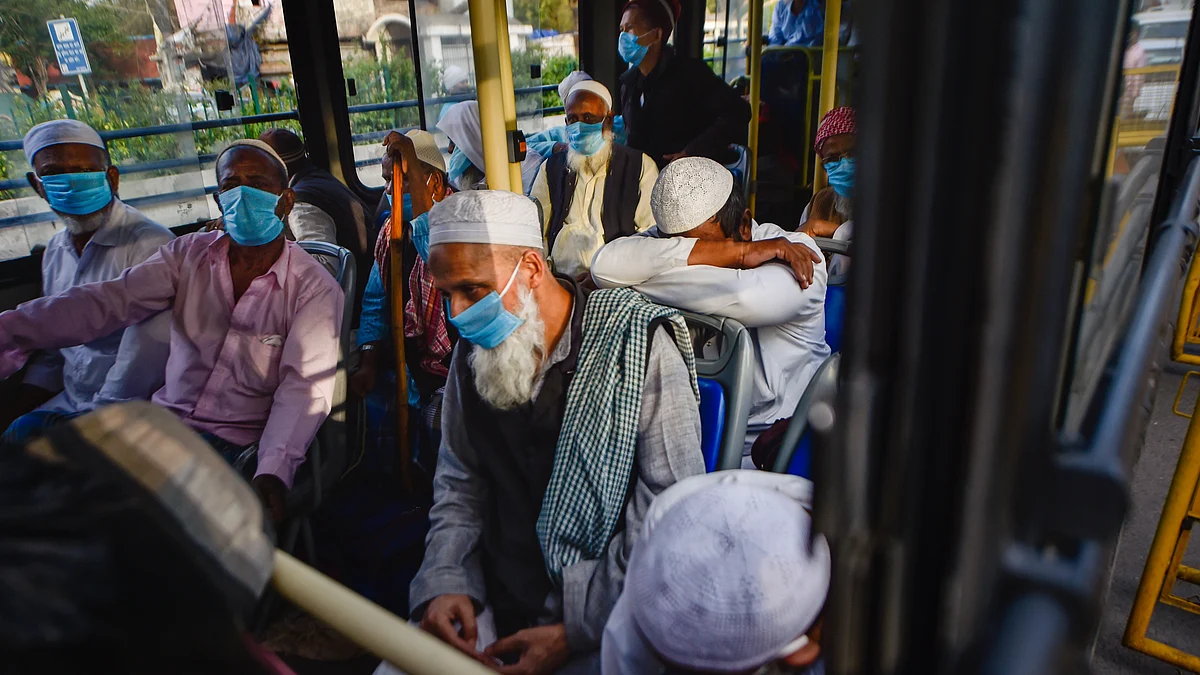
The spread of the COVID-19 infection from a Tablighi Jamaat ijtema (gathering) in New Delhi has become an occasion for stoking the flames of Islamophobia that have been licking this country for a while. Many TV channels are accusing the Tablighi Jamaat of “endangering India” being “anti-national”, and the head of the BJP IT cell has tweeted that this is part of an “Islamic insurrection”.I
Indians may not be aware of it, but the Tabligh is the largest Islamic movement in the world, and they are headquartered a couple of kilometres away from the Parliament House, in the New Delhi suburb of Nizamuddin. That you have not heard of it is not because it is sinister, but that it is fairly innocuous.

8 New COVID-19 Cases in Assam, All Participated in Tablighi Jamaat

Tablighi Jamaat Cannot Evade Responsibility

The Tablighi Jamaat leadership should have displayed better sense in conducting the ijtema itself, given the already deteriorating public health environment around the country. At Prime Minister Modi’s call, Holi 2020 on March 10 was already a remarkably subdued affair and people began to avoid large gatherings. Truth be told, till he ordered a lockdown on the evening of March 24, the seriousness of the situation did not really get through. To blame the Tabligh alone for the chaos that accompanied their ijtema is to willfully ignore the fact that the outbreak caught everyone unawares, witness the large and unorganized movement of migrants across the country under conditions of great hardship.
The Tabligh deserves to be condemned, but it is not as though they deliberately set about spreading the infection, after all, the first to be affected are fellow Tablighis and Muslims.
And they were not the only ones who whose recklessness was born out of ignorance, many other personalities in the country ranging from starlet Kanika Kapoor to Karnataka Chief Minister Yediyurappa and Yogi Adityanath were involved in public gatherings a week after the ijtema. If it comes to blunders in handling the Covid threat, even greater personalities like Xi Jinping and Donald Trump are in line before the Tablighi Jamaat leadership.

Indian State and Tablighi Jamaat

Unlike the Jamaat-e-Islami or the Jamiat ulema-e-Hind, the Tablighi Jamaat (TJ) membership tends to be poor, inward looking and the central message of the Tabligh in India is detachment from worldly affairs. Not many who readily condemn the organisation, not in the least the equally medieval TV anchors, are really familiar with the outfit and the role it has played in this country.
Given its vast influence in the Islamic world, our intelligence services have good links with the outfit, evidenced by NSA Ajit Doval’s involvement in clearing the Markaz off its unwelcome guests last month.
But this is a discreet contact and the Tablighis tend to avoid the limelight to the extent they can.
As for politicians, they have been kept at  distance by the Tablighi Jamaat. Since the outfit has no public interface and does not publish or declare any authoritative statement of its organisation or ideas, it has no way of endorsing or attacking any political party. That is by choice more than anything else.
Also Read

Tablighi Jamaat is Not Like Jamaat-e-Islaami

Authorities in India have not seen the Tablighi Jamaat as an Islamist organisation and it was not, like the Jamaat-e-Islami, banned during the Emergency. The Tabligh has never been accused of encouraging terrorism or violence of any kind. However, Riyaz Bhatkal or Riyaz Shahbandri, and Irfan Bhatkal of the Indian Mujahideen used the Tablighi global network to reach out to Islamists across the world.
An important reason why Indian Muslims were not affected by the kind of violent religious extremism that affected the world in the last forty years is because of organisations like the Tablighi Jamaat which is orthodox, but quietist.
Its leadership has largely been statist, in that they support the government of the day and self-consciously avoid all politics and focus on what orthodox Muslims say is the greater jihad—the struggle within for faith and piety.
The partition of the country and the creation of Pakistan played an important role in shaping the ideology of the outfit. Suddenly Muslims had to come to terms with the fact that they were a minority. And hence, Maulana Yusuf the head of the outfit between 1945-1965, encouraged the inward looking approach. In fact, scholar Yoginder Sikand has said that the  spread of the organization around the world is because it encourages its followers to come to terms with the secular world by personalising Islam and “making a defacto distinction between religion and politics.


Tablighi Jamaat and the Global Jihad

Western intelligence agencies have long accused the Tablighi Jamaat of promoting radicalisation. In its annual report in 2005, the German domestic intelligence organisation BfV claimed that Tablighi Jamaat had played a particularly “important role in the process of radicalisation” of socially and economically disadvantaged Muslims because of their technique of debate and discussion.
The FBI was more cautious when its chief Robert Mueller told a Senate Committee on Intelligence in February 2005  that “individual members of legitimate organizations such as Jama’at Tabligh, may be targeted by al-Qa’ida in an effort to exploit their networks and contacts here in the United States.”
Actually, as a Stratfor analysis put it in 2008, there is an indirect connect between the Tablighi Jamaat and the world of global jihad. This is the one that arises “when Tablighis disgruntled with the group’s apolitical program could break orbit and join militant organisations.” Certainly, given its very nature, it provides a large pool of the pious who can further the lesser jihad machine.
Zia ul Haq encouraged the Tablighi Jamaat hoping it would keep the influence of the Jamaat-e-Islami at bay. But over time, like the Deobandis, the Tablighis, too, became militant in the country. One of them, Lt Gen Javid Nasir became the chief of the ISI and another Rafiq Tarrar was the President of Pakistan who Musharraf displaced in his coup.
The Quint April 2, 2020

Thursday, April 16, 2020

Training guns at China

Reports that the death toll in Wuhan may have been many, many times higher than the 2,535 revealed, will feed into the narrative demanding accountability from China on account of the Covid-19 spread.
Training guns at China
As a Chinese diplomat in India has put it, ‘China neither created the virus nor intentionally transmitted it.’ Also, the Chinese instituted an unprecedented lockdown of an entire province and took what the diplomat said were ‘most comprehensive, rigorous and thorough measures’. True, but early action could have checked its spread dramatically. The authorities in the city were aware of the virus by around mid-December, but orders for a lockdown were only issued on January 23. Timely action was sacrificed to what the Chinese Communist Party (CPC) calls ‘social stability’, and the early whistle-blowers were punished for broadcasting information on it.
But from here to raise the demand for compensation or reparations is another thing. When it comes to reparations, maybe some others would also be on the list. In the 1960s, the US used Agent Orange, a chemical that destroyed nearly 5 million acres of forest and exposed millions of Vietnamese to its effects. And then, there is the Iraq War of 2003, based on fictitious premises, that devastated an entire nation and led to tens of thousands of deaths.
Yes, the Chinese must be held to account in a manner that will encourage them to change their systems and protocols and provide a learning experience to the rest of the world. We have yet to hear the final word on Covid-19.
Chinese culpability is bound to play out strongly in the US. As of Monday, the US led in the number of Covid-positive cases at nearly 1.5 lakh (about 2,500 deaths). The helplessness of the world’s leading military and economic power will become even more manifest in the coming weeks as the virus peaks and takes an even greater toll.
Even if the US was not in an election year, there would have been a great deal of finger-pointing going on. Given the upcoming presidential elections, it could take on a nastier edge. The Trump administration knew about the virus as of January this year, but failed to act with dispatch. Given the Trump style, he will focus the blame on everyone but himself, and China will be a big target indeed.
Whatever may have been the bitterness over the usage of the terms ‘Chinese virus’ and ‘Wuhan virus’ across the world, the most popular nomenclature has already taken root and it is ‘coronavirus’. People will not forget where it originated, but are unlikely to think beyond that.
Journalist and author Praveen Swami has brought out in a recent article in Firstpost that unknown viruses arising from the animal-human interaction lurk in half a dozen places in India. Any of them could be a candidate for reaching the stage of highly contagious human-to-human interaction. So, a little bit of humility would suggest that the world needs to focus on mitigating the physical and economic consequences of such viruses, rather than play the blame game.
But for the US and China, this is not merely about scoring debating points, but part of a more ruthless geopolitical competition. Covid-19 is merely the latest episode in a narrative that is emerging from the US, which feels it has been cheated by China. The Americans went into China as part of a legitimate and successful strategy of outflanking the erstwhile Soviet Union. Then, US scholars began to suggest that as it became more prosperous, it would, as per their modernisation theories, become more democratic. That has not happened, at least till now, instead, the CPC has been able to maintain its authoritarian hold over the people through co-option and coercion and the country has continued to grow economically and militarily in the past decades.
The competition now has two pressing aspects. One is in the realm of technology, where the US is determined to ensure its superiority. While China may take the lead in a few areas like 5G, there is nothing to indicate that the US can be bested in its overall superiority in the realm of science and technology in the next decade and more.
The other aspect is the military competition in East Asia. Since 1950, the US maintained a deployment close to China, buttressed by its alliances with South Korea, Japan, Taiwan and the Philippines. Despite US complaints about being taken for a ride by its allies, nothing really has changed here, indeed, it now also has the advantage of having a friendly Vietnam as well.
The increasingly powerful Chinese military may be able to keep the US some distance from its shores, but beyond that the US remains, and will remain, the dominant power for the foreseeable future.
China is the only country today which is able to pose some kind of a challenge to the US, be it in technology or economy or diplomacy. The US seems to have reached a point of insecurity, where it views every challenge as life-threatening. It is unable or unwilling to concede any ground to a country which is a growing power and which has its own needs and aspirations.
Political change in China, which many await, is not something that can be imposed by others; it must come from within. In the meantime, the task for the US and the global community is to be able to shape the circumstances through which this change can come.
Tribune March 31, 2020